
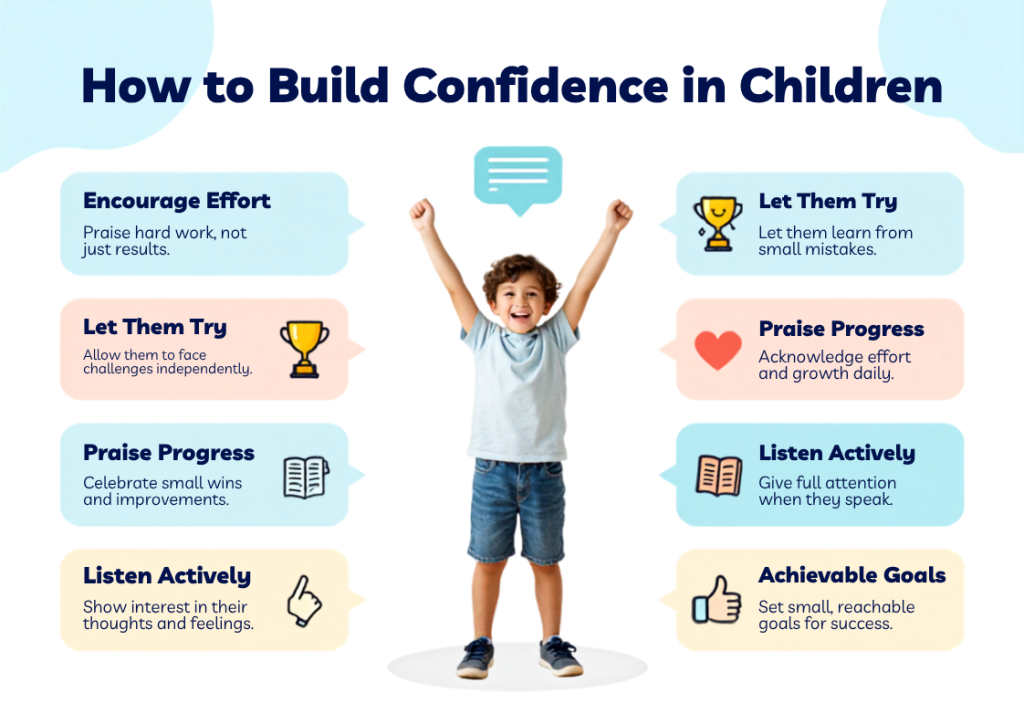
Building confidence in children is one of the most important responsibilities of parents and teachers. A child’s confidence shapes their personality, behavior, academic performance, communication skills, and future success.
Confident children are more likely to try new things, handle challenges, express their thoughts, and recover from failure. On the other hand, children with low confidence often struggle with fear, hesitation, shyness, and self-doubt.
In today’s world, many children face confidence issues due to pressure from school, comparison with others, excessive screen time, lack of emotional support, and parenting mistakes.
This article provides a complete, practical, and psychology-based guide on how to build confidence in children step by step.
Understanding Confidence in Children
Confidence means a child believes in their abilities and feels capable of handling different situations.
It includes:
- Self-belief
- Emotional security
- Positive self-image
- Ability to try new things
- Ability to handle failure
Confidence is not something children are born with. It is developed through environment, parenting style, and experiences.
Psychologists say that early childhood experiences play a major role in shaping self-esteem and confidence.
Signs of Low Confidence in Children
Before improving confidence, parents must recognize the signs:
- Child avoids speaking in front of others
- Hesitates to try new activities
- Fear of making mistakes
- Overdependence on parents
- Low participation in school
- Negative self-talk like “I can’t do it”
These signs show that a child needs emotional and behavioral support.
Main Causes of Low Confidence in Kids
1. Excessive Criticism
When children are constantly corrected or scolded, they start believing they are not good enough.
2. Comparison with Others
Comparing a child with siblings or classmates creates emotional pressure and insecurity.
3. Over-Protection
When parents do everything for the child, they never learn independence.
4. Lack of Emotional Attention
Children need emotional connection more than material support.
5. Fear-Based Environment
Strict punishment creates fear, not confidence.
Psychology Behind Child Confidence
Child confidence develops through three main psychological factors:
Emotional Safety
The child must feel safe, loved, and accepted.
Positive Reinforcement
Encouragement increases motivation and self-belief.
Independence
Allowing children to make decisions builds internal strength.
Step-by-Step Guide: How to Build Confidence in Children
Step 1: Create a Safe Emotional Environment
Children should feel that home is a safe place where they are accepted.
Say things like:
- You are important
- I believe in you
- It’s okay to make mistakes
This builds emotional stability.
Step 2: Appreciate Effort Instead of Results
Instead of focusing only on success, focus on effort.
Instead of saying:
“You are very smart”
Say:
“I like how hard you tried”
This teaches growth mindset.
Step 3: Give Small Responsibilities
Children gain confidence when they feel responsible.
Examples:
- Packing school bag
- Helping in simple chores
- Managing study time
Step 4: Encourage Decision Making
Let children make small choices:
- What to wear
- What book to read
- Which activity to do
This builds independence.
Step 5: Allow Safe Failure
Failure is a part of learning.
Children should be allowed to:
- Make mistakes
- Try again
- Learn from experience
Step 6: Avoid Negative Labels
Never call a child:
- Lazy
- Weak
- Stupid
- Shy
These words damage self-image permanently.
Step 7: Build Communication Skills
Encourage children to talk daily:
- About their day
- Their feelings
- Their thoughts
Communication builds confidence.
Child Confidence Building Activities
1. Storytelling Practice
Children express ideas through stories.
2. Role Play Activities
They act as teachers, leaders, or professionals.
3. Public Speaking Practice
Start with family conversations.
4. Creative Arts
Drawing, painting, and crafts improve expression.
5. Group Activities
Improve social confidence.
Real-Life Example
A 9-year-old child was extremely shy and avoided speaking in class.
His parents changed their approach:
- Stopped criticism
- Started daily encouragement
- Gave small responsibilities
- Practiced speaking at home
After 2–3 months:
- Child started speaking in class
- Became more active
- Confidence improved significantly
This shows that consistent parenting changes behavior.
Common Mistakes Parents Make
1. Over-Controlling
Children become dependent and lack confidence.
2. Constant Criticism
Reduces self-esteem.
3. Comparison
Creates insecurity.
4. Ignoring Emotions
Children feel unimportant.
Expert Parenting Strategies
- Be patient with growth
- Focus on effort, not perfection
- Encourage independence
- Support emotional expression
- Celebrate small achievements
Parenting Tip
Confidence is not built by pressure. It is built by support, patience, and experience.
Frequently Asked Questions
How can I build confidence in my child?
By giving emotional support, encouraging independence, and appreciating effort.
What causes low confidence in children?
Criticism, comparison, fear-based parenting, and lack of attention.
Can shy children become confident?
Yes, with proper guidance and consistent practice.
What activities help build confidence?
Role play, storytelling, speaking practice, and responsibility tasks.
Conclusion
Building confidence in children is a long-term process. It requires patience, understanding, and positive parenting.
When children feel safe, supported, and valued, they naturally develop confidence that helps them succeed in life.
Call to Action
MotherChild.Care provides structured programs for:
- Child Confidence Building
- Parenting Support
- Study Success Programs
- Emotional Development