
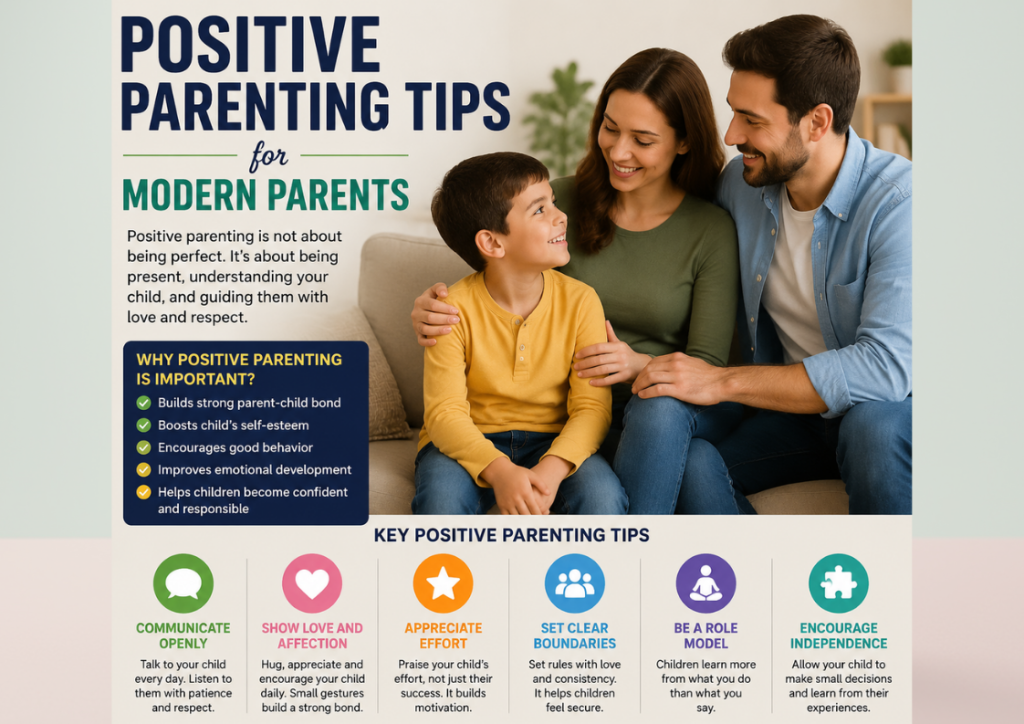
Parenting in today’s world is very different from the past. Modern parents face new challenges such as mobile addiction, social media influence, academic pressure, emotional stress, and behavioral issues in children.
Many parents want to raise confident, disciplined, and successful children, but they often struggle with the right approach. Strict parenting methods no longer work effectively in today’s environment. Instead, positive parenting has become one of the most effective approaches for healthy child development.
Positive parenting focuses on understanding the child’s emotions, encouraging good behavior, building confidence, and creating a strong parent-child relationship.
This article provides a complete guide on positive parenting tips for modern parents that can help improve behavior, emotional intelligence, and long-term success in children.
Understanding Positive Parenting
Positive parenting is a parenting approach that focuses on guidance rather than punishment. It encourages parents to build a strong emotional connection with their children while teaching discipline, responsibility, and life skills.
In positive parenting, children are treated with respect, understanding, and empathy. Instead of fear-based control, it focuses on communication and emotional support.
Positive parenting helps in:
- Building self-esteem in children
- Improving emotional development
- Strengthening family relationships
- Developing good behavior naturally
- Increasing confidence and motivation
Why Modern Parents Need Positive Parenting
Modern children are exposed to:
- Technology and mobile phones
- Social media influence
- Competitive education systems
- Less outdoor activity
- Emotional isolation
Because of these changes, traditional strict parenting methods often fail.
Children today need:
- Emotional understanding
- Communication
- Guidance instead of pressure
- Balanced discipline
- Supportive environment
This is why positive parenting is more effective in modern families.
Key Positive Parenting Tips for Modern Parents
1. Build Emotional Connection First
Children listen to parents who they feel emotionally connected to.
Spend time daily with your child without distractions. Listen to them carefully and show interest in their thoughts.
2. Focus on Understanding Behavior, Not Controlling It
Instead of reacting to behavior, try to understand why the child is behaving in a certain way.
For example, if a child is angry or stubborn, it may be due to stress, lack of attention, or emotional frustration.
3. Encourage Open Communication
Children should feel safe to express their thoughts without fear of punishment.
Ask questions like:
- How was your day
- What made you happy today
- What problems did you face
4. Replace Punishment with Guidance
Punishment creates fear, but guidance creates learning.
Instead of shouting or strict punishment, explain consequences and guide children toward better choices.
5. Appreciate Effort, Not Just Results
Modern parenting should focus on effort rather than perfection.
When children are appreciated for trying, they become more confident and motivated.
6. Set Clear but Flexible Boundaries
Children need rules, but those rules should be clear and reasonable.
Examples:
- Fixed study time
- Limited screen time
- Proper sleep schedule
7. Be a Role Model
Children copy what they see.
If parents are calm, disciplined, and respectful, children naturally learn the same behavior.
Positive Parenting and Child Behavior Development
Child behavior development is strongly influenced by parenting style.
Positive parenting helps children:
- Develop self-control
- Learn emotional regulation
- Build respectful communication
- Understand responsibility
- Improve decision-making skills
When children feel supported, their behavior improves naturally.
Emotional Development in Children
Emotional development is a key part of positive parenting.
Parents should help children understand:
- Their emotions
- How to express feelings
- How to handle frustration
- How to deal with failure
This leads to stronger emotional intelligence.
Common Parenting Mistakes
Many modern parents unknowingly make mistakes such as:
1. Over-Controlling Children
Too much control reduces independence.
2. Ignoring Emotions
Children need emotional attention more than material things.
3. Excessive Criticism
Constant criticism damages self-esteem in children.
4. Comparing Children
Comparison creates insecurity and low confidence.
Positive Parenting Strategies for Daily Life
Create Daily Routine
Children perform better with structure.
Spend Quality Time
Even 20 minutes of focused time matters.
Encourage Independence
Let children make small decisions.
Teach Responsibility
Give age-appropriate tasks.
Stay Calm During Conflicts
Avoid reacting with anger.
Real-Life Example
A 10-year-old child was becoming aggressive and refusing to study. His parents initially used strict punishment, but it did not improve behavior.
Later, they shifted to positive parenting methods. They started communicating more, reduced criticism, created a routine, and appreciated small improvements.
Within a few weeks, the child’s behavior improved, and he became more cooperative and confident.
This shows that positive parenting creates long-term behavioral change.
Parenting Tips for Confidence
Positive parenting plays a major role in building self-esteem in children.
Parents should:
- Encourage small achievements
- Avoid negative labeling
- Support decision-making
- Give emotional support
- Allow mistakes as learning opportunities
Child Motivation Techniques
To motivate children:
- Set achievable goals
- Celebrate progress
- Give encouragement
- Create a positive environment
- Avoid pressure-based expectations
Motivation grows when children feel supported, not forced.
Frequently Asked Questions
What is positive parenting?
Positive parenting is a child-centered approach focused on guidance, communication, and emotional support instead of punishment.
How does positive parenting help children?
It improves confidence, behavior, emotional development, and academic performance.
Can positive parenting improve discipline?
Yes, discipline improves naturally through consistency and guidance.
Is positive parenting suitable for all ages?
Yes, it works for children of all ages when applied correctly.
Conclusion
Positive parenting is one of the most effective approaches for raising children in today’s modern world. It focuses on emotional connection, guidance, understanding, and long-term development rather than fear or punishment.
When parents adopt positive parenting strategies, children become more confident, responsible, and emotionally strong.
The goal is not just to control behavior but to develop a strong personality that prepares children for life success.
Call to Action
MotherChild.Care supports parents with:
- Positive Parenting Programs
- Child Behavior Development
- Confidence Building
- Study Success Training
Contact us today:
Email: info@motherchild.care