
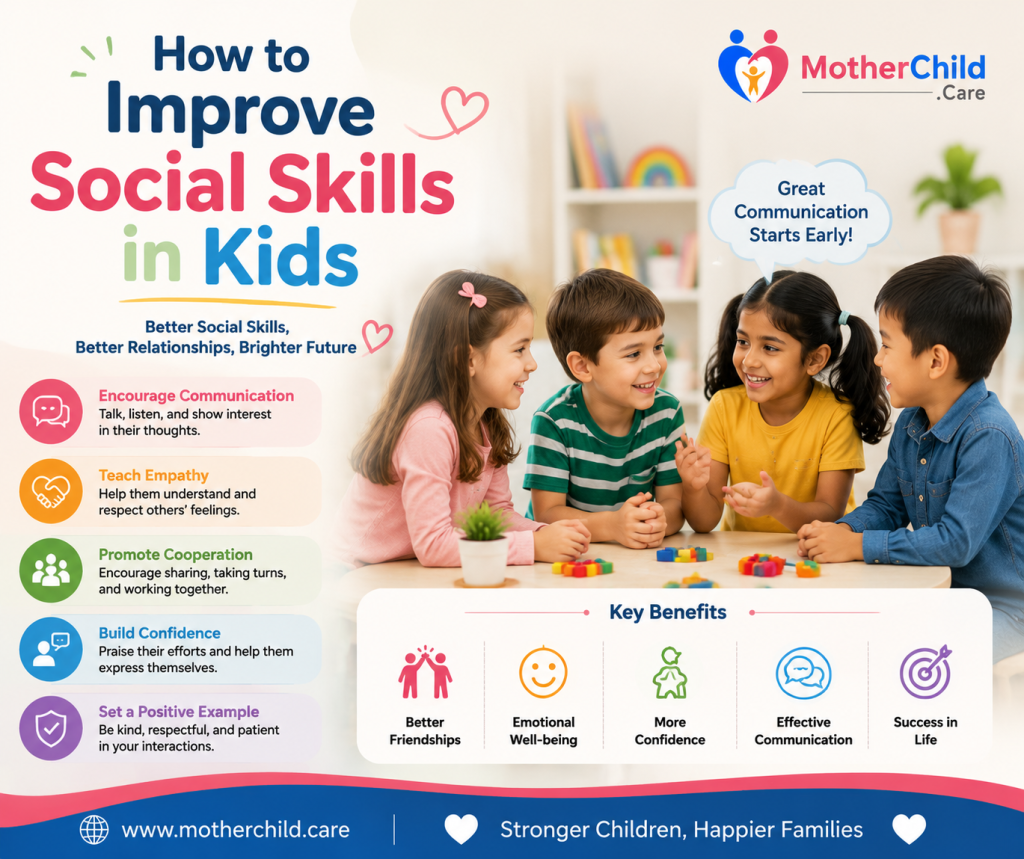
Social skills are one of the most important foundations of a child’s future success. They influence how children communicate, make friends, express emotions, handle conflicts, and adapt to different environments. A child with strong social skills feels confident in school, performs better academically, and builds healthier relationships throughout life.
However, many parents today notice that their children struggle in social situations. Some children are extremely shy, avoid speaking in groups, or hesitate to make friends. Others may become overly aggressive, interrupt conversations, or fail to understand social boundaries. These challenges are often linked with emotional development in children and early child behavior development patterns.
In modern times, increased screen usage, reduced outdoor play, and limited face-to-face interaction have contributed to low confidence in kids when it comes to communication. As a result, parents are increasingly searching for how to build confidence in children and improve their ability to interact positively with others.
The good news is that social skills are not fixed. They can be learned, practiced, and improved at any stage of childhood. With the right parenting strategies, emotional support, and structured child confidence building activities, children can become confident communicators who feel comfortable in any social setting.
This guide is designed to help parents, teachers, and guardians understand how to increase self confidence in child and develop strong social abilities using practical, real-life methods.
Understanding Social Skills in Children (Psychology Perspective)
Social skills are a combination of communication, emotional awareness, empathy, listening ability, and behavior regulation. These skills help children interact effectively with others and build meaningful relationships.
From a psychological perspective, social development begins early in childhood. The brain learns through observation, imitation, and experience. Children watch how adults speak, react, and behave in different situations, and they copy those patterns.
The development of social skills is closely linked with emotional development in children. A child who understands emotions is more likely to respond appropriately in social situations. On the other hand, a child with poor emotional awareness may struggle with misunderstandings, frustration, or isolation.
There are three core components of social skills:
First is communication, which includes speaking clearly and listening actively.
Second is emotional intelligence, which helps children understand their own emotions and those of others.
Third is behavior regulation, which allows children to control impulses and respond appropriately in social environments.
When these three areas are developed properly, children naturally become confident, respectful, and socially balanced individuals.
Causes of Poor Social Skills in Kids
Poor social skills do not develop suddenly. They are shaped by environment, habits, and emotional experiences.
One major cause is excessive screen time. When children spend too much time on mobile devices, they miss real-life interactions that are essential for communication development.
Another cause is lack of social exposure. Children who do not interact with peers regularly may feel uncomfortable in group settings.
Overprotective parenting can also contribute. When children are not allowed to speak for themselves or solve social problems, they become dependent and less confident.
Emotional insecurity plays a major role as well. Children who fear judgment or criticism may avoid social interactions altogether.
Language barriers or communication delays can also affect confidence in expressing thoughts.
Negative past experiences, such as being teased or ignored, may lead to social withdrawal.
All these factors contribute to low confidence in kids and difficulties in building friendships.
Step-by-Step Guide: How to Improve Social Skills in Kids
The first step is encouraging daily communication at home. Simple conversations help children build confidence in expressing thoughts.
The second step is active listening. When children feel heard, they become more confident in speaking with others.
The third step is teaching basic manners and greetings. Simple habits like saying hello, thank you, and goodbye form the foundation of social behavior.
The fourth step is encouraging group activities. Interaction with peers helps children practice real-life communication.
The fifth step is role-playing social situations. Practicing how to introduce oneself or join a group helps reduce anxiety.
The sixth step is teaching empathy. Help children understand how others feel in different situations.
The seventh step is correcting behavior gently. Avoid harsh criticism, as it can damage self esteem in children.
The eighth step is limiting screen time and encouraging real-world interactions.
The ninth step is providing positive feedback when the child shows improvement.
The tenth step is consistency. Social skills develop gradually through repeated practice.
These steps are essential parts of positive parenting strategies and long-term communication development.
Real-Life Example: A Child’s Social Transformation
A 9-year-old girl named Mariam was extremely shy and avoided talking to classmates. She struggled with group activities and often preferred staying alone. Her parents were concerned about her parenting guide for shy child behavior.
At first, they tried forcing her to speak, but this increased her anxiety. Later, they changed their approach.
They began small conversations at home and encouraged her to express opinions without fear. They also introduced child confidence building activities such as storytelling, role-play, and group games with cousins.
Gradually, Mariam started participating in conversations. She became more comfortable speaking in small groups and eventually made close friends at school.
Her transformation was not instant. It happened through patience, emotional support, and structured practice.
Common Mistakes Parents Make
One common mistake is forcing children to interact before they are ready. This can increase fear instead of confidence.
Another mistake is labeling a child as “shy” or “rude,” which affects self esteem in children.
Some parents compare their child with more outgoing peers, creating pressure and insecurity.
Overprotection also limits opportunities for social learning.
Ignoring emotional needs is another issue. Children need emotional validation to feel safe in social situations.
Inconsistent guidance confuses children and slows development.
Avoiding these mistakes is essential for healthy child behavior development.
9. Expert Parenting Strategies for Social Skills Development
Experts recommend “guided exposure,” where children are slowly introduced to social environments in a supportive way.
Another strategy is emotional coaching, helping children understand feelings during social interactions.
Modeling behavior is also important. Children learn communication by observing adults.
Encouraging storytelling improves verbal expression and confidence.
Group play activities help children learn cooperation and teamwork.
Using positive parenting strategies ensures children feel supported rather than pressured.
These methods significantly improve how to build confidence in children and long-term social development.
Activities Section: Practical Exercises to Improve Social Skills
Simple activities can greatly improve communication and confidence.
Group games like board games or sports teach teamwork and patience.
Storytelling sessions help children express ideas clearly.
Role-playing exercises simulate real-life social situations.
Family discussions improve communication and listening skills.
Community activities or school participation build real-world interaction skills.
Drawing emotions helps children express feelings non-verbally.
These child confidence building activities strengthen both emotional and social development.
Frequently Asked Questions (FAQ)
Why does my child struggle with social skills?
Children may struggle due to lack of exposure, excessive screen time, emotional insecurity, or overprotective parenting.
How to build confidence in children socially?
Through practice, emotional support, child confidence building activities, and positive reinforcement.
What causes low confidence in kids in social situations?
Fear of judgment, lack of experience, criticism, and comparison with others.
What are the best parenting tips for confidence?
Encourage communication, avoid criticism, and provide safe social environments.
How does emotional development in children affect social skills?
Strong emotional development helps children understand and respond better in social interactions.
What activities improve social skills in children?
Group games, storytelling, role-play, and family discussions.
Conclusion
Social skills are essential for a child’s emotional, academic, and personal success. They shape how children connect with the world, build friendships, and express themselves.
With the right guidance, patience, and consistent practice, every child can develop strong communication abilities and emotional intelligence.
Parents play a key role in shaping these skills through support, encouragement, and positive experiences. When children feel understood and accepted, they naturally grow into confident and socially capable individuals.
Notic parents
At MotherChild.Care, we are dedicated to helping parents raise confident, emotionally strong, and socially skilled children. Explore more expert parenting guides on how to build confidence in children, improve behavior, and support emotional development in children.
Visit MotherChild.Care to discover practical strategies that help your child build lifelong social skills and meaningful relationships.